
~/mbmapps/articles $ open the-intelligence-improves-your-world-remains
The Intelligence Improves. Your World Remains.
AI's durable advantage is not a clever prompt or agent diagram. It is a faithful operating world with observation, memory, authority, feedback, and proof.
There are moments in history when a new technology arrives, and for a while, we misunderstand what it is.
We see the first automobile and think: a faster horse.
We see the first computer and think: a better calculator.
We see the early internet and think: a quicker way to send mail.
And when artificial intelligence entered the public imagination, many of us made the same mistake.
We thought it was a better way to answer questions.
We studied the machinery around the edges
So we learned how to prompt it.
We learned which words produced better responses. We built elaborate instructions. We connected databases. We gave models tools. Then we built agents, and agents that managed other agents, and diagrams showing how all those agents should talk to one another.
And much of that work mattered.
But it may turn out that we were studying the machinery around the edges of something much larger.
Because the most important question is no longer simply:
How intelligent can these models become?
The more important question is:
How much of that intelligence can we actually put to work?
The brilliant employee in an empty room
Imagine, for a moment, the most brilliant employee your company has ever hired.
This person can reason across disciplines. They can write software, analyze financial information, understand contracts, study customer behavior, develop a plan, explain that plan, and revise it when circumstances change.
But on their first day, you put them in an empty room.
No access to the company's records.
No understanding of what happened yesterday.
No authority to make a decision.
No ability to contact anyone.
No way to see whether their recommendations worked.
And every few hours, they forget most of what happened before.
We would never look at that employee and conclude that intelligence was the problem.
We would conclude that we had designed a terrible workplace.
And that, in many ways, is what we have done with artificial intelligence.
We have spent enormous energy asking models to become smarter while giving surprisingly little attention to the world in which that intelligence operates.
That is beginning to change.
Intelligence needs a world
The next generation of AI systems will not simply receive better prompts.
They will be able to understand the state of the world around them.
They will know what has happened, what is happening, what is supposed to happen, and what remains unresolved.
They will be able to investigate when they do not know something rather than pretending that they do.
They will use tools.
They will take actions.
They will observe the consequences.
They will test whether those consequences match what was intended.
And when they fail, the system will help them understand why.
That distinction matters.
Because intelligence without observation is guesswork.
Intelligence without memory repeats itself.
Intelligence without authority can only advise.
Intelligence without feedback cannot improve.
And intelligence without verification can be confidently wrong.
From screens to situations
So the architecture of the future may look very different from the software we grew up building.
For decades, we designed applications around screens.
A customer screen.
An inventory screen.
A staffing screen.
A quoting screen.
A reporting screen.
Every screen represented another place where a human being had to translate reality into software.
Artificial intelligence gives us the opportunity to reverse that relationship.
Instead of asking:
What screen should the user fill out?
We can begin asking:
What does the system need to understand about the real world?
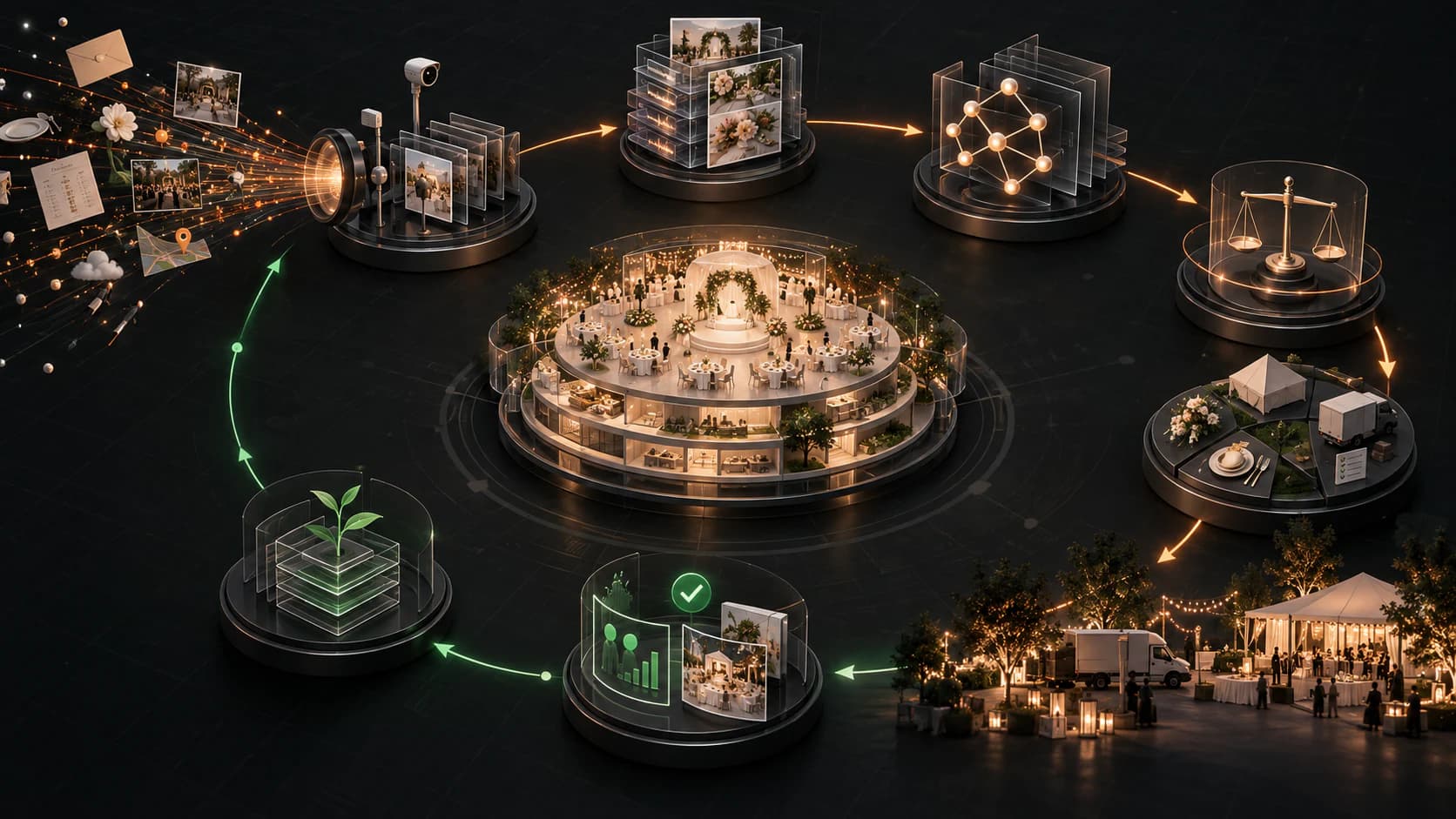
The wedding becomes a living object
Consider a catering company preparing for a wedding.
Traditionally, the information is scattered everywhere.
The sales team knows what the client promised.
The chef knows what must be prepared.
Someone else knows which ingredients are in the refrigerator.
Another person knows who is available Saturday.
The contract sits in one system.
The recipes sit somewhere else.
The latest guest count may be buried in an email.
And the owner carries half the operation in his head.
Then something changes.
Twenty more guests.
A dietary restriction.
A cook calls in sick.
A shipment arrives short.
Today, human beings become the integration layer.
They make phone calls. Send text messages. Update spreadsheets. Walk into the kitchen. Ask questions. Recalculate. And hope that everyone is now working from the same reality.
But imagine a different system.
The wedding itself becomes a living object.
It knows the client commitment. It knows the menu. The recipes. The ingredient requirements. The inventory available. The items that still need purchasing. The staff required. The employees available. The equipment needed. The timeline. The venue constraints. The expected margin. And the work that remains unfinished.
Now change the guest count.
The consequences propagate.
Food requirements change. Purchasing changes. Production changes. Labor requirements may change. Cost changes. Margin changes.
The system does not merely tell us that something changed.
It begins reasoning about what that change means.
And here we arrive at something bigger than an AI feature.
We arrive at a new way of representing an organization.
Delegated judgment
Because once the system can understand the world, another question becomes possible:
What authority should we give it?
Perhaps at first the AI can only observe.
Then it can recommend.
Later, it can prepare an action for approval.
Eventually, within carefully defined boundaries, it may act on its own.
It might discover that an ingredient shortage threatens Saturday's event. Find three approved vendors. Compare price, delivery time, and reliability. Prepare the purchase. And if the order is below an established threshold and meets company policy, place it.
But if the substitution affects an allergen, a contractual commitment, or an important customer preference, it stops and asks a human being.
That is not simply automation.
That is delegated judgment.
And delegated judgment requires something much more sophisticated than a clever prompt.
It requires policy.
It requires boundaries.
It requires evidence.
It requires accountability.
It requires us to decide which decisions belong to machines, which decisions belong to people, and where the two should work together.
That may become one of the defining design problems of this technological era.
Infrastructure becomes infrastructure
There is another lesson here.
For years, developers have raced to build increasingly complicated AI infrastructure.
Prompt frameworks. Vector databases. Agent routers. Memory systems. Multi-agent orchestration.
Much of that experimentation was necessary.
But history suggests that generic infrastructure eventually becomes infrastructure.
Databases became services.
Servers became clouds.
Payments became APIs.
And now parts of the machinery required to run AI agents are becoming platforms as well.
Which means the durable advantage may not belong to the company with the cleverest agent diagram.
It may belong to the company that understands its world better than anyone else.
The company that has represented its business with enough fidelity that intelligence can operate inside it.
Its customers. Its commitments. Its resources. Its constraints. Its history. Its objectives. Its rules. Its definition of success.
That is the deeper opportunity.
Not artificial intelligence sprinkled across the old software.
But software redesigned around the presence of intelligence.
The intelligence improves. Your world remains.
And that distinction matters because AI models will continue improving.
The model you use today will not be the model you use three years from now.
So building your advantage around today's model is fragile.
But build a rich representation of your business—give intelligence the ability to observe it, give it tools to affect it, give it memory, give it feedback, give it clear authority, and give it a way to know whether it succeeded—and every improvement in the underlying model makes the entire system more capable.
The intelligence improves.
Your world remains.
That may be one of the most important architectural principles of the AI era.
And it should also give us some humility.
We are still early.
Some ideas we consider best practice today will look primitive surprisingly soon.
Some systems that appear sophisticated today will collapse under real-world complexity.
And some of the most valuable discoveries will come not from making AI more complicated, but from finally understanding what information, authority, and feedback intelligence actually needs.
The question changes
So perhaps the next great breakthrough will not be another prompt.
Or another agent framework.
Or another model leaderboard.
Perhaps it will come when we stop treating artificial intelligence as something that sits inside a little box waiting for instructions—and begin designing the world around it so that intelligence can participate meaningfully in the work.
Because the real promise of this technology has never been that machines will suddenly know everything.
The promise is that, for the first time, we may be able to build systems that can understand a situation, reason about what should happen next, act within boundaries, observe the result, and help us make the next decision better than the last.
And once we understand that, the question changes.
We stop asking:
Where can we add AI?
And we begin asking:
What could this organization become if intelligence were part of its operating system?
That is a much bigger question.
And we are only beginning to answer it.